140 Years of Backworth Colliery Band
- Home
- 140 Years of Backworth Colliery Band
Our History
From the Coalfields to the Present Day
Backworth Colliery Band was established in 1886 within the social and cultural life of Backworth’s mining community. Over the following 140 years the mines disappeared, generations changed and brass banding itself evolved, but the band continued.
This is the story of a musical tradition that has changed with its community while keeping its colliery identity, told alongside the story of Backworth itself.
1813–1980
Before the Band: Backworth’s Mining Heritage
Coal was mined around Backworth from the early 1700s, but there was no mining in the village itself: the 90-fathom fault threw the seams far below the surface. In 1812 a group of partners whose developments were largely due to John Buddle, the most notable mining engineer of his day, leased the Backworth royalty from the Duke of Northumberland. Ground was broken on the first pit, the ‘A’ Pit, in August 1813, coal production began in September 1818, and the first shipment left Whitehill Point aboard the Nailer on 10 September that year.
Over the following century the enterprise grew into a network of pits, including the Maude, Algernon, Church, Fenwick, Bates and Eccles, served by the company’s own railway to staithes on the Tyne. New villages were built at Backworth, East Holywell, Holywell and Shiremoor to house the workforce. Sunk between 1905 and 1906 and named after company director Richard Eccles, the Eccles was the deepest pit in the Northumberland coalfield at 1,440 feet. Mining was never without cost: explosions in 1928 and the early 1930s claimed seven lives.
This industrial community is the world from which the band emerged. Several of the colliery’s steam locomotives survive in preservation today, most notably at the Tanfield Railway.
Read more about the pits in Remembering Backworth Colliery.
1878–1886
An Earlier Band, and a Foundation
Records suggest organised banding existed in Backworth before the band’s recognised foundation date: a Backworth band appears in contest records at North Shields as early as 1878, and took its first recorded contest win at Cramlington in 1883.
The recognised foundation year of Backworth Colliery Band is 1886, when the band was formally established as Backworth Institute, part of the social life surrounding the mine workings. Its membership was traditionally drawn heavily from miners and local families. From 1886 to 2026 makes 140 years.
1886–1920s
From Wind Band to Brass Band
Backworth did not begin with the instrumentation of a modern brass band. Like many colliery bands it started as a wind band, with clarinets and flutes alongside the brass, and became a wholly brass ensemble during the 1920s.
Contesting was part of band life from the start. Backworth hosted its own brass band contests in 1898 and 1902, and the band won the First Section at the Newcastle Contest in 1904.
1920s–1940s
A Colliery Community Band
For nearly 80 years the band rehearsed in the Miners’ Welfare, across the road from Backworth Club. Concerts, contests, parades, colliery gatherings and civic performances were all part of its life, and its support was closely linked to the mining community.
Between 1929 and 1938 the band made regular appearances at the Crystal Palace national contests, finishing third in 1937. In 1949 it became North of England Area champions in the Second Section and went on to compete at the National Finals.
1947–1980
The Pits Closed. The Band Played On.
Britain’s collieries were nationalised on 1 January 1947, and Backworth’s pits became one production unit of the National Coal Board. As markets fell, the ageing pits closed one by one: the Maude in 1960, the Algernon in 1966 and the Fenwick on 31 August 1973, while the railway to the river closed in 1969. The Eccles was the last to go, in May 1980, and rail traffic ended on 17 July 1980, bringing 167 years of unbroken deep mining at Backworth to a close.
The industry that created the environment the band emerged from had disappeared. The band had not. It had competed at the National Finals in the Third Section in 1968, and it kept playing for its community as the pits fell silent.
1980s–1990s
Keeping the Tradition Alive
As mining employment disappeared, the band’s membership changed. Where earlier generations were drawn from the pits, players now came from a growing range of occupations and backgrounds, and the band became a community organisation preserving its colliery heritage while many other bands in the area folded.
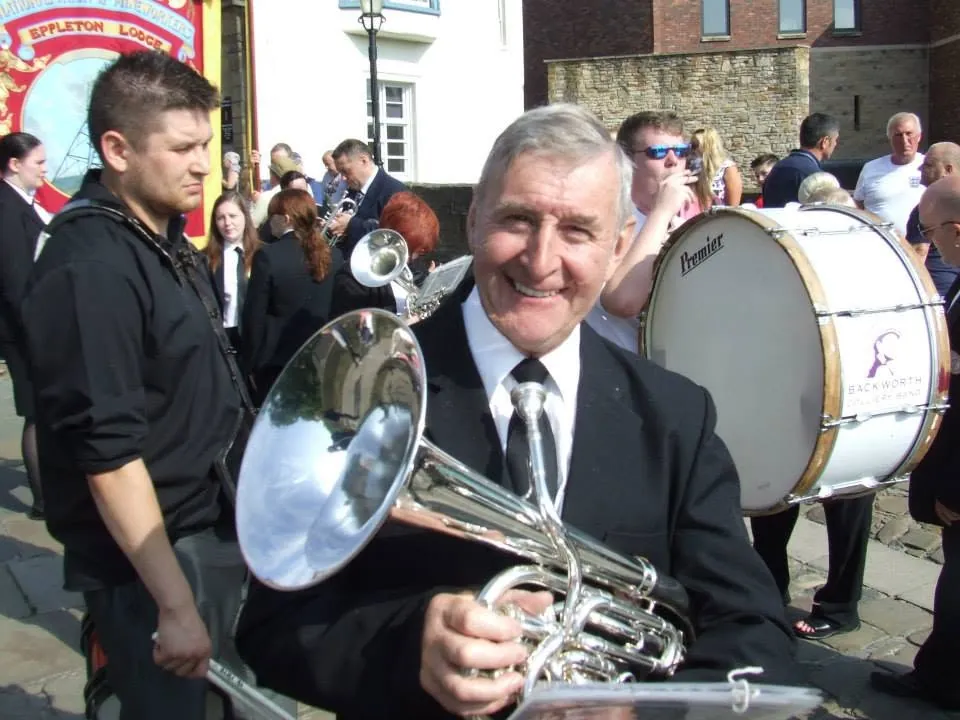
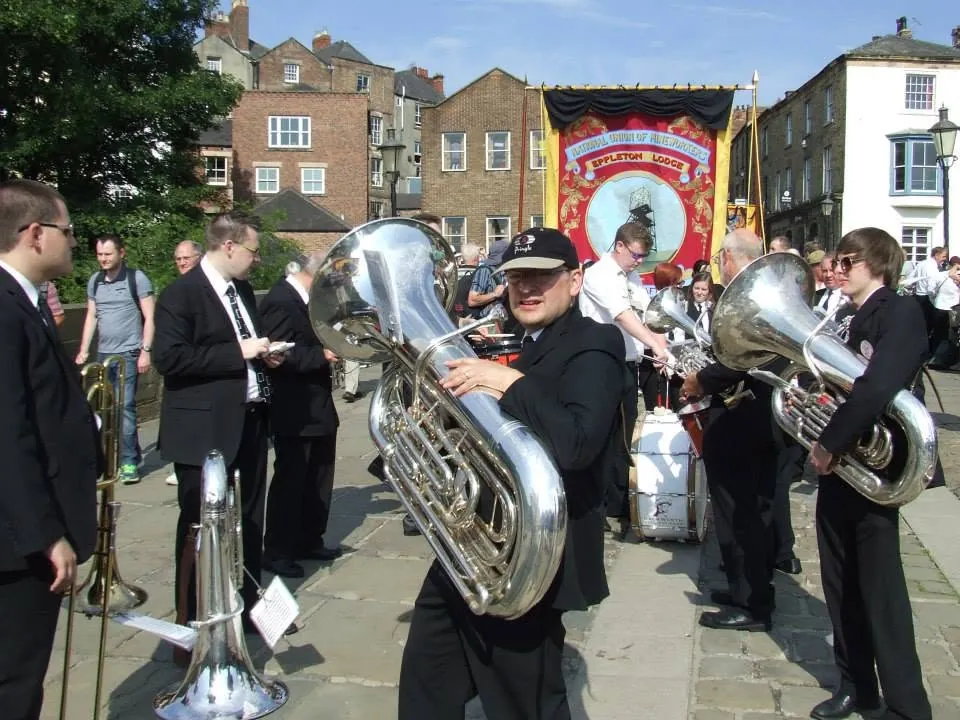
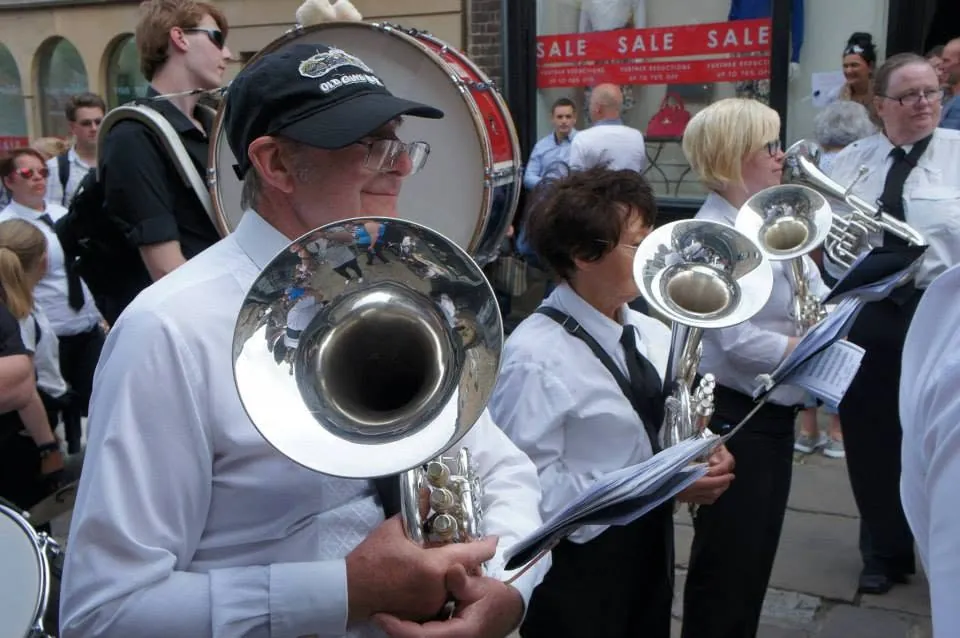
It continued to play at the Durham Miners’ Gala, on Whit Friday, at CISWO events, regional contests, concerts and community events. The band’s archive also records performances at the Theatre Royal, Newcastle and Whitley Bay Playhouse, and appearances on BBC Look North, BBC Antiques Roadshow, BBC The Money Programme, GMTV and BBC Radio Newcastle.
2000–2009
The Five Rivers Years and a New Home
2000. Sponsorship from the Five Rivers Group of Salisbury led to the band performing as Five Rivers Brass. The sponsorship lasted only 12 months, but the band kept the name for seven years. This was Backworth Colliery Band under a sponsored name, not a separate band. In 2001 it finished second at the National Mineworkers Championships.
2004. The band moved from the Miners’ Welfare to the Into Change Centre at Moorside, and a junior band was formed as a route into senior-band playing, led by Dennis Taylor and local members.
2005. The band became North of England Area champions in the Fourth Section and competed at the National Finals, earning promotion to the Third Section. It also won contests as far afield as Whitehaven and Durham, and the Durham County Brass Band Association contest in 2006 and 2008.
24 June 2007. The band formally returned to its original name. The archived announcement reads: “As of today, the band formerly known as Five Rivers Brass are reverting back to their original name, the Backworth Colliery Band.” The relaunch brought a new logo and website, a £24,000 fundraising project for new instruments and music, and a research project into the band’s history, with a renewed emphasis on Backworth, community, colliery heritage and youth development.
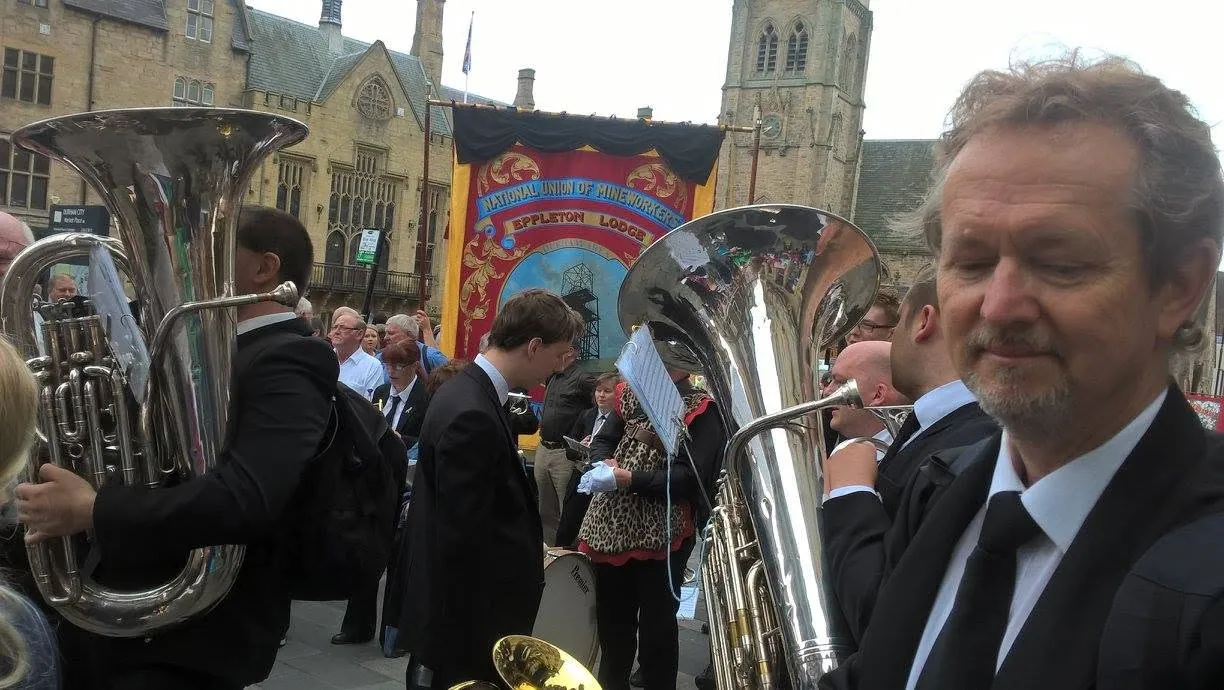
2009. After five years as Musical Director, long-serving member Colin Harris passed on the baton, and Tony Griffiths was appointed Resident Musical Director. That summer the band marched at the Durham Miners’ Gala in its purple and gold.
2015–2025
Recent Years
The band finished third in the Fourth Section of the North of England Regional Championships in 2015, 2020 and 2022, and second at the Durham County Brass Band Association contest in 2022.
2023. Fourth place at the Regional Championships, alongside Whit Friday, appearances at Beamish, the Durham Miners’ Gala, the North Tyneside Steam Railway, Newcastle Pride, Dalston Village Festival and Royal Quays Marina, a Battle of Britain remembrance service and a joint concert with Backworth Male Voice Choir.
2024. Third place in the Fourth Section at the Regional Championships, with a Best Euphonium award, plus Whit Friday, the Stanley Entertainment Contest, community concerts and the launch of the Christmas ice rink at Newcastle’s Life Science Centre.
2025. Seventh place at the Regional Championships, with a further Best Euphonium award.
Recent test pieces include Indian Summer (2026), Music for a Festival and I, Daedalus (2025), Four Cities Symphony and Music for Jock Tamson (2024), and The Four Noble Truths and Hungerford Town (2023). See the band’s full contest record on brassbandresults.co.uk.
2026
140 Years, and the Story Continues
2026 marks 140 years since the band’s recognised establishment in 1886. The anniversary is a chance to celebrate the people who have carried the music forward, and to preserve their stories for future generations.
Share your Backworth memories. Do you have a programme, photograph or memory connected with the band? Get in touch and help us build the archive.
The tradition continues through performances, new players and the Training Band.